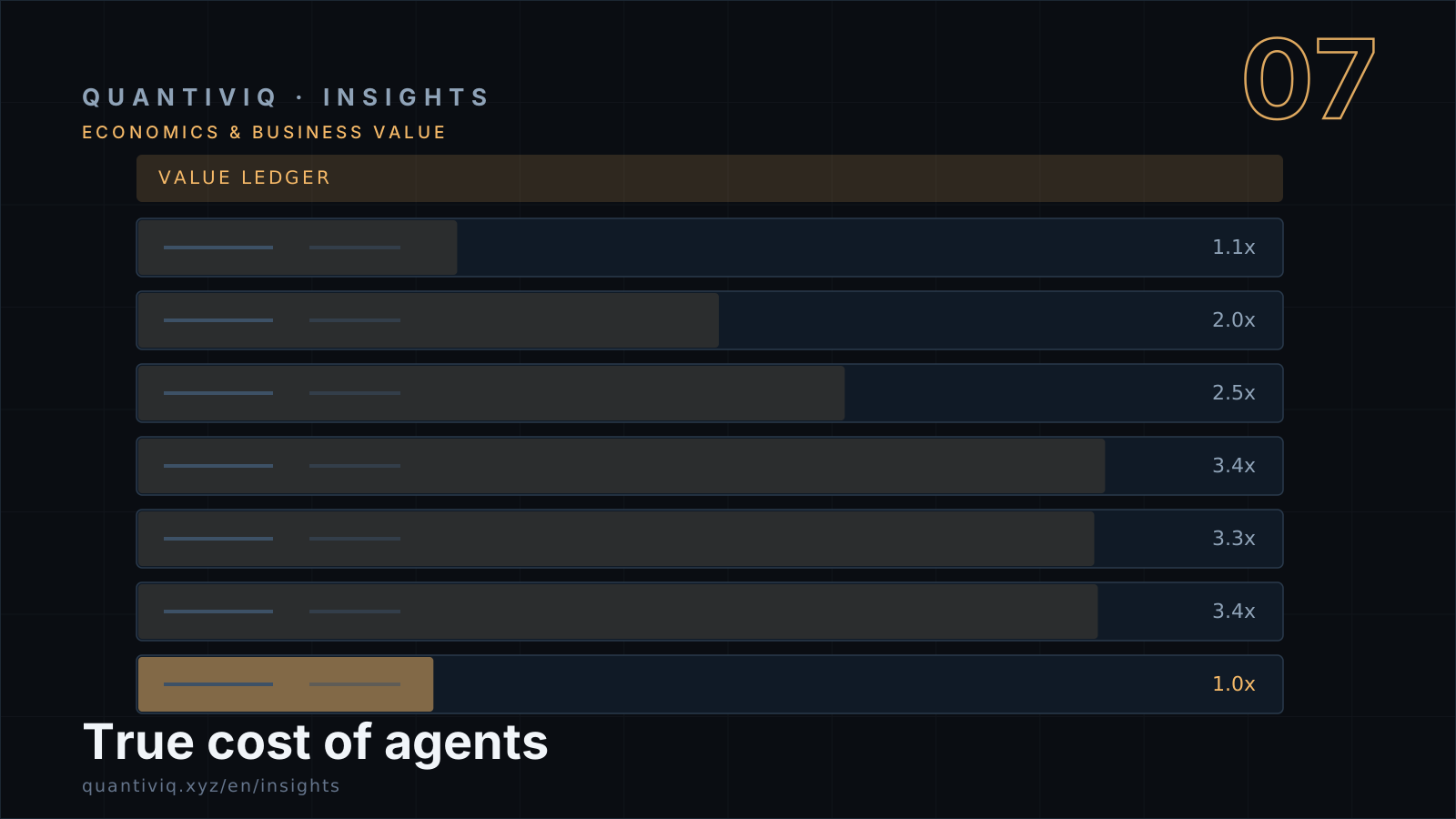
The true cost of an enterprise AI agent decomposes into eight cost classes: inference and compute, infrastructure, evaluation, supervision, security and compliance, integration, maintenance, and failure with rework. In most real deployments, the first class — the API bill that dominated the vendor pitch — is the smallest or second-smallest line. Supervision time and failure rework dominate at scale. Programs that budget the visible tenth and discover the other nine tenths in production are the single most common mid-year budget surprise in AI transformation, and they map exactly onto the failure pattern Gartner forecasts for this cycle: agentic projects canceled on escalating costs, unclear value and inadequate risk controls.
The economics are shifting underneath this. BCG's October 2026 analysis of technology budgets — reported by Jornal Económico and other trade coverage — estimates enterprise AI investment roughly doubled in about a year, to around 3.3% of company revenues, with spending moving decisively outside traditional IT budget lines.[1] When AI was 0.3% of revenue, cost modeling could be sloppy and nobody would notice. At 3.3% and climbing, the cost stack is the program's economics.
Executive Summary
- Agent economics are a stack of eight cost classes; inference — the line every procurement conversation starts with — is typically the smallest or second-smallest at production scale.
- Supervision (human review and exception handling) is usually the largest line and scales with autonomy levels, not with licenses: per-seat thinking systematically under-prices agents, which consume compute per task and human attention per exception.[3]
- Early missions skew toward integration and evaluation costs; mature missions skew toward inference and supervision — the stack's shape changes as missions age, and budgets must be re-profiled accordingly.
- Gartner's forecast that more than 40% of agentic AI projects will be canceled by end of 2027 names escalating costs as a leading cause — the mid-year cliff is a budgeting failure, not a technology failure.[2]
- Cost control without capability destruction is possible: price autonomy by reversibility, invest in evaluation as failure insurance, and harvest reusable capability so each mission's fixed costs are paid once.[2]
The visible tenth
Procurement anchors on the wrong number. Model pricing is published, comparable across vendors, and feels like a negotiation; a per-seat or per-token line is legible in a way that "supervision load" is not. But the pricing structure of agents breaks the per-seat intuition at its foundation: a copilot user consumes one license and modest, bounded usage, while an autonomous agent consumes compute per task executed — and task volume scales with the workflow, not with headcount. An agent fleet doing invoice triage across 400,000 monthly documents does not care how many employees you have.
The deeper problem is that model prices are falling while agent programs are getting more expensive, because the falling line is the small one. Inference gets cheaper every quarter; supervision, integration, governance and failure management do not. An executive team that models agent economics primarily as a model-price question will find the program's costs rising even as the vendor's unit prices fall — the stack's center of gravity is below the waterline.
The eight cost classes
| # | Class | What drives it | Scales with | Control lever |
|---|---|---|---|---|
| 1 | Inference & compute | Tokens per task, model tier, retries, routing | Task volume × verbosity | Model routing, caching, prompt discipline, output budgets |
| 2 | Infrastructure | Vector stores, orchestration layers, observability, environments | Fleet size, retention | Shared platform over per-mission builds |
| 3 | Evaluation | Golden set construction, rubric grading, regression runs, human grading time | Task variety, change frequency | Reused eval assets from the capability library |
| 4 | Supervision | Human review time, exception queues, escalation handling | Autonomy level, error rate, volume | Autonomy tiers by reversibility; review sampling by observed error rate |
| 5 | Security & compliance | Access reviews, red-teaming, audit trails, incident response | Risk tier, regulated surface | Proportionality: controls scaled to risk, not uniform depth |
| 6 | Integration | Data plumbing, permissions, API contracts, upstream change management | Systems touched | Standard connectors; capabilities reused across missions |
| 7 | Maintenance | Model and version drift, prompt decay, eval refresh | Live fleet age, upstream churn | Scheduled eval refresh; drift monitors |
| 8 | Failure & rework | Error propagation, rollbacks, customer-facing mistakes, recovery work | Error rate × blast radius | Evaluation investment; guarded rollout; kill switches |
Two structural observations. First, classes 3 through 8 are all organizational costs — they buy human attention, discipline and infrastructure — which is why they surprise teams who modeled the program as a software purchase. Second, the classes interact: every dollar of evaluation (class 3) reduces failure and rework (class 8) and supervision load (class 4), because an agent with a rigorous eval harness ships fewer errors and earns higher autonomy faster. The cheapest supervision is the supervision you stop needing because the eval suite did its job — the core argument of Gartner's agent-reality guidance that reliability, not autonomy, is the binding constraint on agent value.[3]
Supervision deserves its own warning. It is the cost class most often unbudgeted because it is denominated in minutes of existing employees' time rather than invoices. A review protocol that adds four minutes of human attention per hundred agent actions sounds trivial — until the fleet executes two million actions a month and the review load is a full-time-equivalent spread across the people least likely to have slack. Fake oversight is the failure mode at the other end: queues back up, review latency grows, and approvers rubber-stamp to clear the backlog, converting "human-in-the-loop" into theater. The supervision-design analysis covers the design side; the budgeting side is simply this: supervision is a real, forecastable line item, priced as review-minutes per thousand actions times loaded hourly cost.
How the stack shifts as missions mature
The cost stack is not static. Consider two missions in one portfolio (an illustrative synthetic scenario, not a specific company; assumptions stated so the arithmetic can be checked):
- Mission A, month one: invoice-exception triage, 20,000 documents/month. Integration dominates (data access, permission mapping, connector work: ~40% of spend), evaluation is heavy (golden set construction from 2,000 historical cases: ~20%), inference is minor (~10%), supervision modest (~15%), the remainder spread across security, infrastructure and failure handling.
- Mission A, month nine: same volume, tuned fleet. Integration has amortized to near zero for this workflow, evaluation is a refresh-and-regression cadence (~10%), inference has grown to ~30% of monthly spend (volume-driven), and supervision has fallen with the error rate but plateaus (~25%) — the residual is the exception queue that genuinely needs humans.
The re-profiling is the point: early budgets buy plumbing and proof; steady-state budgets buy throughput and attention. A program funded on the month-one profile will overrun in month nine, and one funded on the month-nine profile will starve its own integration work. Deloitte's longitudinal State of Generative AI research has flagged the same pattern from the value side across its survey waves: organizations sustain value when they keep funding the unglamorous foundations — governance, data, skills — past the pilot phase, and ROI persistence remains the chronic weakness of programs that treat launch as the finish line.[4]
Why budgets blow up mid-year
Connect the pieces and the mid-year cliff stops being mysterious. A program budgets inference and licenses (classes 1-2, the visible tenth). The pilot runs; integration was absorbed by a platform team that didn't charge the mission, evaluation was done once as a project artifact, supervision was informal. The pilot "succeeds" — and is scaled. Task volume multiplies by ten. Now the unbudgeted lines surface together: the platform team's costs get allocated, the eval set is stale so error rates climb, supervision load scales with the errors, and failure rework shows up in the business function's own metrics. Finance sees a program whose costs tripled while its booked value lagged, exactly when the value case was supposed to mature.
This is the mechanism behind Gartner's forecast that more than 40% of agentic AI projects will be canceled by end of 2027, with escalating costs, unclear value and inadequate risk controls as the named causes — a forecast, not an observed outcome, but one whose causal logic is visible in every cost stack that was never actually modeled.[2] BCG's budget-shift finding sharpens the stakes: with AI investment around 3.3% of revenue and rising (per secondary coverage of BCG's analysis), a systematic mispricing of the cost stack is no longer a rounding error at the enterprise level.[1]
Cost control that doesn't kill value
The levers are known, and none of them is "use a cheaper model and hope":
- Price autonomy before granting it. Every autonomy tier carries an expected supervision cost — sample rates, review minutes, escalation handling. A mission's ledger entry books that cost next to its inference cost, so promotions up the autonomy ladder are priced decisions, not drift. Reversibility is the pricing variable: cheap to supervise what you can undo.
- Buy evaluation as failure insurance. The eval harness is the only line item that reduces other lines — supervision, failure, maintenance — while increasing the mission's earned autonomy. The evaluation framework treats this as the control loop's foundation; the budget treats it as the cheapest premium in the stack.
- Run FinOps for tokens. Model routing (cheap models for easy cases, strong models for hard ones), response caching for repeated patterns, output-length discipline, per-mission spend budgets with alerts. These are engineering disciplines, not vendor negotiations, and they routinely halve class-1 costs.
- Pay integration once. The capability-library pattern from the mission factory model turns per-mission plumbing into platform assets; the second mission over the same systems should cost a fraction of the first.
- Budget the stack, review the stack. Each mission's ledger entry carries all eight classes with a named owner. Quarterly, the review board sees cost per successful outcome — not per call, not per seat — because that is the number that tells you whether the agent is worth its attention bill.[3]
The composite cost shares above are illustrative practice-based ranges, not survey data — your stack's shape depends on your workflows, risk tiers and volume. The discipline is the transferable part: model all eight classes, price autonomy, measure cost per outcome, and re-profile the budget as missions age. Do that, and the mid-year cliff becomes a quarterly line-item conversation. Fail to do it, and the arithmetic eventually holds the conversation for you — usually the week before the steering committee meets.
Key Takeaways
- Eight cost classes, not one: inference, infrastructure, evaluation, supervision, security, integration, maintenance, failure/rework — and the visible API line is typically the smallest or second-smallest at scale.
- Agents consume compute per task and human attention per exception; per-seat pricing under-prices both, and task volume scales with the workflow, not the headcount.
- Supervision is the stealth line: unbudgeted because it hides in existing employees' minutes, decisive because it scales with error rates at fleet volume.[3]
- The stack re-profiles as missions mature — integration-heavy early, inference-and-supervision-heavy later — and budgets funded on one profile overrun on the other.[4]
- The mid-year budget cliff is the predictable result of budgeting the visible tenth; Gartner's >40% cancellation forecast names its causes exactly.[2]
- The control levers are autonomy pricing, evaluation investment, token FinOps, capability reuse, and cost-per-outcome reporting — all disciplines, none of them vendor-dependent.
What Leaders Should Do Next
- Rebuild the cost model for the largest live agent deployment across all eight classes. (CFO office + platform lead, first 30 days.) Include the informal lines: platform team time, review minutes, business-function rework. The delta between that model and the approved budget is the size of your exposure.
- Instrument cost per successful outcome. (Mission leads, first 60 days.) Total stack cost ÷ successful task completions, per mission, on the monthly review. Per-call and per-seat metrics answer vendor questions; this number answers the investment question.
- Attach a supervision forecast to every autonomy tier. (Transformation office, first 60 days.) Sample rate × volume × review minutes × loaded cost, booked in the mission ledger entry before any promotion up the autonomy ladder.
- Fund evaluation as a first-class budget line, not project overhead. (CTO, first 90 days.) Golden sets, grading time and regression infrastructure funded explicitly — the only spend in the stack that reduces the others.[3]
- Set token FinOps standards centrally. (Platform team, first 90 days.) Routing policy, caching defaults, output budgets, per-mission spend alerts — applied to every mission by default so each team doesn't rediscover the discipline.
References
- Boston Consulting Group — How AI Is Reshaping the Economics of Technology, Oct 2, 2026; ~3.3%-of-revenue and doubling figures via Jornal Económico and other trade coverage. bcg.com — budget-share shift; secondary coverage of exhibit figures.
- Gartner — Over 40% of Agentic AI Projects Will Be Canceled by End of 2027, Jun 25, 2025. gartner.com — analyst forecast, not an observed result; causes: escalating costs, unclear value, inadequate risk controls.
- Gartner — AI Agent Success Hinges on Reliability, Not Autonomy, 2025-2026. gartner.com — analyst guidance on scoping autonomy to criticality and reversibility.
- Deloitte — The State of Generative AI in the Enterprise, Q4 report, Jan 2025. deloitte.com — longitudinal enterprise survey; ROI persistence and foundation funding.
Discussion questions
Questions executive teams can use to pressure-test this analysis against their own organization.
- For our largest agent deployment, what is the fully loaded cost per successful business outcome — including human review time, retries and rework — and who owns that number?
- Which of the eight cost classes are currently unbudgeted lines in our AI programs, and when do those lines surface: at pilot end or at scale-up?
- If inference prices halve next year, which of our agent use cases flip from uneconomic to economic — and which stay uneconomic because the cost is supervision, not compute?
4 sources cited · How we research and verify: Editorial methodology. Links verified 2026-10-23.