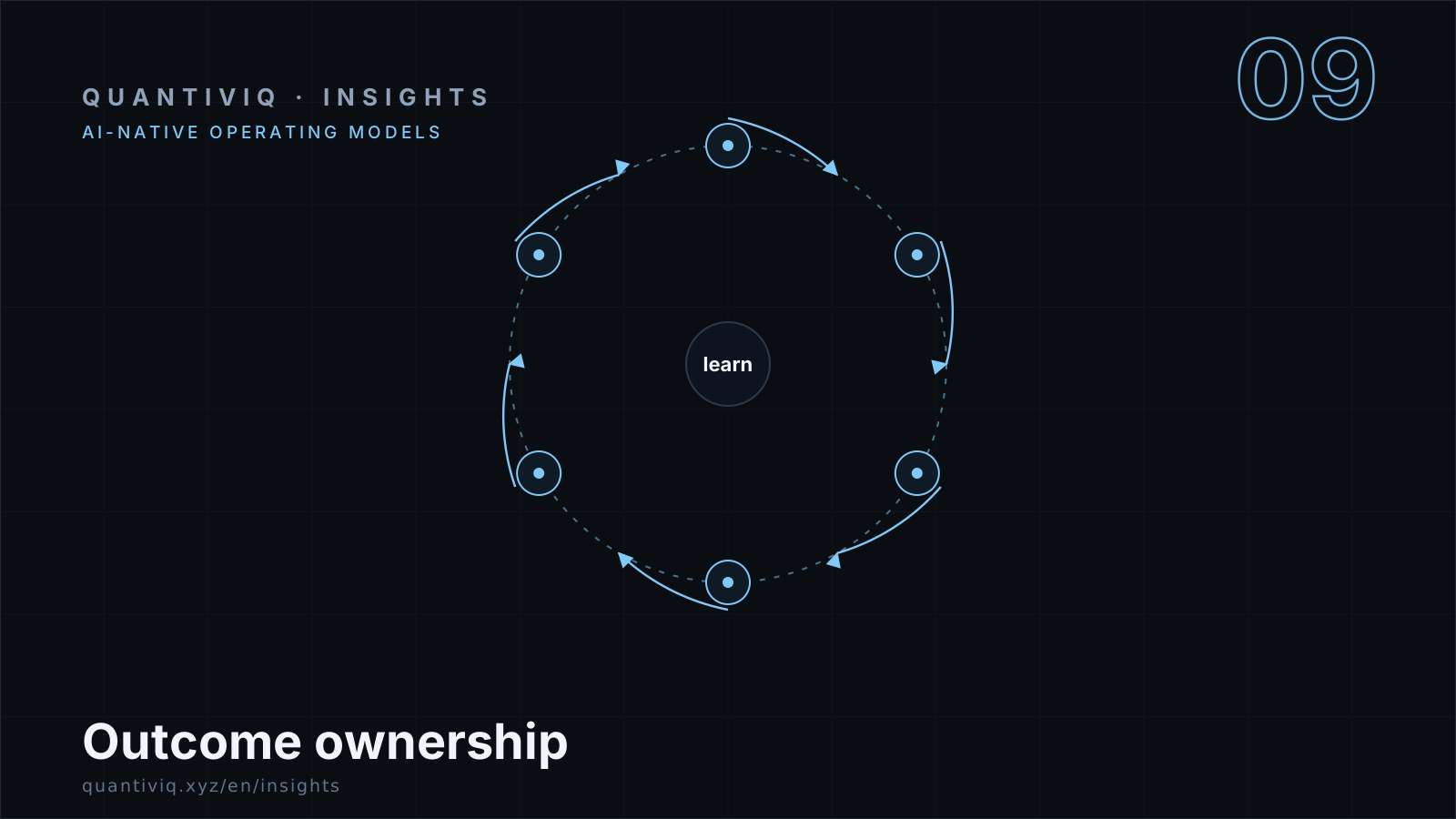
An AI-native product operating model is one in which teams own outcomes (not feature lists), products learn from usage (through explicit, guarded feedback loops), and every release is a hypothesis (evaluated against a measured baseline rather than celebrated as output). Three structural changes define it: outcome ownership as a real authority, the learning loop as a designed mechanism, and data as a product surface. Teams that adopt all three convert usage into improvement; teams that adopt none bolt a chatbot onto a feature factory and call it transformation.
The failure mode this model exists to fix is now well-documented. The organizational argument — that work changes faster than the structures around it, and that the organization itself must therefore change — is the core of McKinsey's October 2026 analysis of AI-era operating models.[1] Nowhere is that more visible than in product delivery: the feature-factory process (roadmap, build, ship, move on) assumes the product's behavior is fixed at ship time. AI-native products violate that assumption by design — their behavior is the product, and behavior changes with every model update, prompt change and feedback cycle. An operating model that treats shipped AI as finished is managing the wrong asset.
Executive Summary
- Three structural changes define the model: named outcome owners with authority to change the producing system; explicit learning loops from production usage back to guarded updates; and data — user interactions, feedback, outcomes — treated as a product surface with consent and privacy as design constraints.
- Feature-factory metrics (velocity, story points, ship dates) measure output; AI-native metrics measure behavior change: task success, outcome movement, cost per outcome.
- Discovery becomes capability-aware: what agents reliably do now defines what to build — the jagged-frontier evidence shows gains inside proven capability and confusion at the boundary.[3]
- Delivery becomes staged rollout with evaluation as the acceptance test; QA becomes an eval suite, not a manual checklist; monitoring tracks behavior drift, not just uptime.[2]
- The metric tree keeps honesty in the boardroom: business outcomes at the top, product behavior in the middle, model quality at the base — and the three are never confused for each other.
Feature factory versus outcome system
The feature factory is not a strawman; it is a rational adaptation to deterministic software. When behavior is fixed at ship time, output — features shipped per quarter — is a defensible proxy for progress. The operating model optimized for it: backlogs, roadmaps, velocity metrics, and teams measured on delivery.
AI-native products break the proxy. A shipped agent feature is not done; it is born, and its behavior will drift with model updates, data shifts and usage patterns it was never tested against. The comparison is stark:
| Dimension | Feature factory | AI-native operating model |
|---|---|---|
| Unit of delivery | Feature/story | Outcome movement (hypothesis → measured result) |
| Success metric | Velocity, ship date | Task success, outcome delta, cost per outcome |
| Release logic | Roadmap commitment | Guarded rollout gated on evaluation results |
| User's role | Requirement source | Signal source (every interaction is feedback) |
| Data's role | Input to requirements | Product surface (consent-managed, eval-feeding) |
| QA | Manual checklist pre-ship | Eval suite, continuously, in production |
| Review cadence | Sprint demo | Weekly metric review against baseline |
| Post-ship posture | Move to next feature | Monitor, learn, improve — the work begins |
The right-hand column is not more work bolted onto the left; it is a different contract between the team and the product. The team that owns an outcome keeps operating the producing system until the outcome moves — and owns the learning loop that makes the movement possible.
Structural change 1: Outcome ownership
An outcome owner is a named person accountable for a measurable business metric — cost-to-serve, conversion, cycle time — with authority to change the system that produces it. The authority clause is what separates real ownership from a scoreboard assignment: an owner who can only file requests to a separate platform team owns a wish list, not an outcome.
This is the product-delivery instance of McKinsey's organizational argument: AI value requires changing the organization around the work — planning, budgeting, performance management — because tools deployed into unchanged structures produce the adoption-without-value pattern.[1] In practice, outcome ownership means: the quarterly plan states the metric and the baseline; the team's autonomy contract (what it may change without approval) is written; and the performance conversation reviews the metric, not the feature count. Microsoft's 2025 Work Trend Index describes the adjacent shift — leadership moving from directing people to orchestrating outcomes through human-and-agent teams in what it calls "frontier firms." It is vendor-sponsored research with an obvious product agenda; treat it as a signpost of the direction, not as evidence of its magnitude.[4]
Structural change 2: The learning loop
The learning loop is the mechanism that converts usage into improvement. It has five stations, and skipping any of them converts the loop into a leak:
- Signal capture. Every meaningful interaction emits structured data: what the agent did, what the user did next, whether the task succeeded. Consent and privacy are design constraints here, not afterthoughts — the governance stack treats data flow as a governed surface.
- Evaluation. Signals feed the eval harness: task success on the golden set refreshed with real production cases, rubric grading of sampled outputs, regression suites on every proposed change.
- Update. Model routing, prompts, retrieval and policies improve — the loop's engine room.
- Guarded rollout. Changes ship to a small traffic slice with a holdout, watched on the eval dashboard, promoted or rolled back on evidence. This is where the productionization discipline and the loop meet.
- Measurement. The outcome metric updates against baseline; the loop's effect is booked — in the product's metrics and, for transformation missions, in the value ledger.
Deloitte and Google Cloud's 2026 point of view on scaling agentic AI names the production disciplines — orchestration, evaluation, guardrails — as the practices that move agents from pilot to production value; the learning loop is simply those disciplines arranged as a cycle rather than a checklist.[2]
Structural change 3: Data as product surface
In a feature factory, data is an input: requirements in, features out. In the AI-native model, data is a surface the product exposes and consumes — every interaction produces training and evaluation material, and the product's data flows are part of its architecture.
Three consequences follow. First, consent and privacy are product design problems: what the product may learn, from whom, under what permission, is specified in the autonomy contract and the data map, not negotiated post-launch. Second, data quality is a product metric: stale retrieval corpora and mislabeled feedback poison the loop silently, so freshness and integrity belong on the monitoring dashboard. Third, the feedback affordance is a designed interface: thumbs-up/down is a toy; structured outcome capture (did the user accept the recommendation, was the invoice reconciled, did the customer return) is the real signal. Products that design their signal capture get compounding learning; products that bolt on a feedback widget get noise.
What the team actually does differently
Discovery becomes capability-aware. The jagged-frontier experiment — 758 consultants, randomized, with AI-assisted consultants completing 12.2% more tasks, 25.1% faster, at over 40% higher quality inside the frontier — also documented that the frontier is invisible: teams could not reliably tell which tasks were inside it.[3] Discovery therefore starts with a capability probe: run the candidate task set against a golden set before committing to build. The probe is cheap (days), and it converts "we think agents can do this" into "agents do this at 87% on our cases" — or fail to, before a quarter of engineering is spent.
Delivery ships guarded rollouts, not launches. The acceptance test is the eval suite passing at threshold, not the demo impressing the room. Traffic ramps 5% → 25% → 100% with a holdout group preserved for attribution — which also feeds the value ledger honestly.
QA evolves into evaluation engineering. Manual test checklists cannot cover an open-ended output space; stratified golden sets, rubric grading and regression suites can, statistically. The QA engineer's craft moves from enumerating cases to designing distributions — arguably a promotion of the discipline, covered in depth in the evaluation framework.
Monitoring watches behavior, not just uptime. Uptime dashboards say the service is up; behavior dashboards say what it is doing. Input distribution drift, output distribution shift, override rate, escalation rate, cost per outcome — the moment any of them moves, the loop has a new input. A product whose behavior drifts unwatched is a product whose learning loop is a straight line down.
The metrics that matter — and the tree that orders them
The metric tree has three levels. At the top, business outcomes: revenue, cost-to-serve, cycle time, retention — the numbers that justify the product's existence. In the middle, product behavior metrics: task success rate, acceptance rate, escalation rate, supervision load — the numbers the team can move weekly. At the base, model quality metrics: eval-set accuracy, rubric scores, latency — the numbers engineers optimize daily.
The tree's discipline is keeping the levels honest with each other. Model quality improves → does behavior move? Behavior improves → does the outcome move? A team reporting eval-set accuracy to the board as if it were value has climbed the tree without connecting the levels; the board should ask for the connections. The value measurement framework extends the same logic to the enterprise portfolio; the product operating model simply applies it one layer down, continuously.
Key Takeaways
- The operating model shifts from shipping features to owning outcomes: named owners, written autonomy contracts, metric-based performance conversations.[1]
- The learning loop — capture, evaluate, update, guarded rollout, measure — is a designed mechanism with five stations; skipping one turns learning into leakage.[2]
- Data is a product surface: consent-managed, quality-monitored, with structured outcome capture designed in rather than bolted on.
- Discovery is capability-aware: probe the frontier with a golden set before committing to build — the frontier is invisible from the whiteboard.[3]
- QA becomes evaluation engineering; monitoring becomes behavior drift tracking; delivery becomes guarded rollout with attribution preserved.
- The metric tree keeps the boardroom honest: outcomes on top, behavior in the middle, model quality at the base — connected, never confused.
What Leaders Should Do Next
- Assign one named outcome owner per AI product, with a written autonomy contract. (CPO, first 30 days.) The contract states what the owner may change without approval; if it is empty, ownership is theater.
- Run a capability probe on the next planned AI feature before committing engineering. (Product lead + agent engineer, first 30 days.) A few hundred real cases against the candidate task set; go/no-go on evidence, in days rather than quarters.[3]
- Instrument the learning loop end to end. (Platform + product engineering, first 60 days.) Structured signal capture, eval harness wired to production, guarded-rollout tooling, and a weekly metric review against baseline.
- Replace the QA checklist with an eval suite for one flagship product. (QA lead, first 90 days.) Stratified golden set, rubric grading, regression runs on every change — with sampled human verification where grading is automated.
- Publish the metric tree for every AI product. (Product leadership, first 90 days.) Outcomes, behavior, model quality — three levels, visible on one page, reviewed monthly at the level that can act on each.
References
- McKinsey & Company — AI is changing work. Now it has to change the organization, Oct 5, 2026. mckinsey.com — organizational-redesign precondition for AI value.
- Deloitte (with Google Cloud) — Scaling Agentic AI to Realize Business Value, 2026. deloitte.com — orchestration/evaluation/guardrails as production practices; vendor-alliance POV.
- Dell'Acqua et al. — Navigating the Jagged Technological Frontier, HBS WP 24-013 (2023), Organization Science (2025), 10.1287/orsc.2025.21838. pubsonline.informs.org — 758-consultant randomized field experiment; frontier-dependent gains, invisible boundary.
- Microsoft — Work Trend Index 2025 ("Frontier Firms"), Apr 24, 2025; cited via Guardian coverage. theguardian.com — vendor-sponsored research; directional signpost only.
Discussion questions
Questions executive teams can use to pressure-test this analysis against their own organization.
- Which of our products would measurably improve if we shipped nothing for a quarter — and what does the honest answer say about our feedback loops?
- For our flagship AI feature, who owns the outcome metric, and can that person change the system that produces it — or only request changes to it?
- What percentage of our last release's value will we be able to attribute six months from now — and is the instrumentation in place to do it?
4 sources cited · How we research and verify: Editorial methodology. Links verified 2026-10-23.