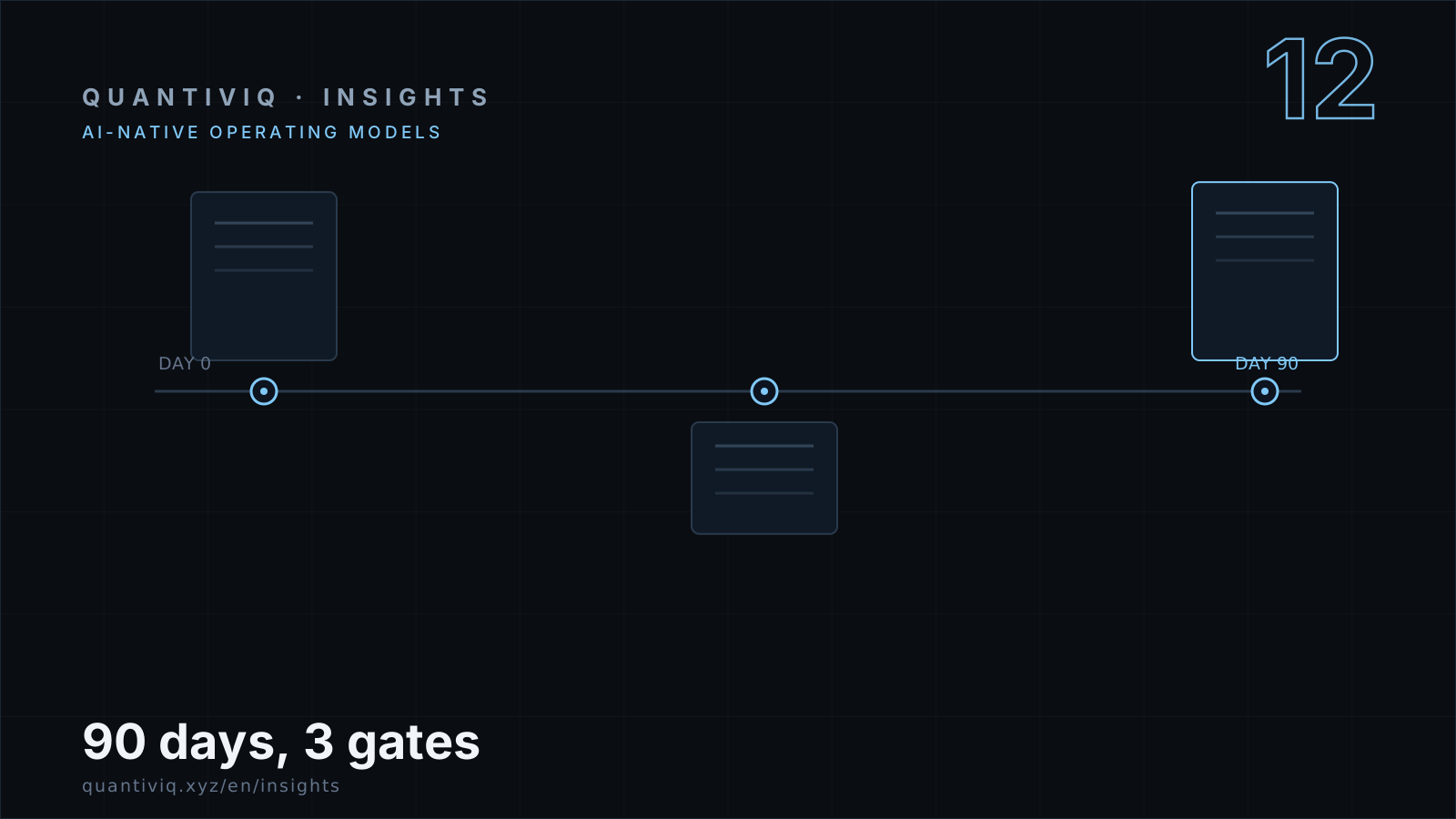
The first ninety days of an AI transformation program decide what it becomes: an operating capability that compounds, or a slide deck re-presented until a budget cycle kills it. The difference is structural. Run the ninety days as three gated phases — Days 1–30 prove one mission end-to-end at small scale with baselines captured; Days 31–60 harden it and book the first value; Days 61–90 scale to a second mission and install the operating rhythm — under one iron rule: every 30-day gate ends with a decision artifact, a go/no-go argued from numbers, never from a demo.
This roadmap is for the leader just handed the mandate — a newly appointed transformation lead, or a CEO kicking the program off personally — with about one quarter to show the program is real. Real has a precise meaning: one measured outcome against a known baseline, one booked net position a CFO can audit, one management rhythm that would survive its sponsor changing roles.
A gate is a funded stop: at day 30, 60 and 90 the team presents its artifact and the sponsor records go, no-go, or fix-and-recheck. A demo answers whether something works; a gate answers what boards fund against — better than what, at what cost.
Executive Summary
- Three gated phases — prove, harden, scale — each closing on a decision artifact: a baseline pack with go/no-go, a booked value-ledger entry, an installed operating rhythm.
- Days 1–30: select one mission through the mission bar and capture baselines before touching the workflow — miss this and later value claims are unattributable.
- Days 31–60: close the production gaps, staff supervision as a budgeted role, and book the first ledger entry with a confidence grade; small or negative is acceptable, unbooked is not.
- October 2026 coverage of McKinsey's State of AI survey put significant financial gains at roughly 6%; deck optimism instead of booked numbers is how that happens.[5]
- Days 61–90: fund mission two from harvested capabilities and install the rhythm — intake, a CFO-chaired review board, a capability library, an autonomy-tier policy.
- Structure comes first; sponsorship multiplies it — Prosci's longitudinal practitioner research ranks active, visible executive sponsorship the top driver of change success.[4]
Days 1–30: Prove One Mission
Select one mission through the bar, not a beauty parade
A mission is the unit of transformation this publication works with: a named workflow with an accountable owner, one outcome metric and a budget — the anatomy is set out in inside an AI-native transformation mission. Candidates clear or fail the mission bar, the prioritization discipline detailed in prioritizing high-value AI missions: recurring volume, an outcome metric with a capturable baseline, feasible data access, real potential to change decision rights, contained blast radius if it fails.
One mission, not five. The first thirty days buy attention, learning and credibility, and all three concentrate. Spread the month across five workflows and the program produces fragments, not proof; bet on one and a measured outcome can exist by day 30.
Capture baselines before touching the workflow
A baseline is the measured pre-AI performance of the exact metric the mission claims to move — cycle time, cost per outcome, quality or rework, plus volume — over enough history to be stable. It must be captured before the workflow changes, and the reason is mechanical: once the process is altered, the counterfactual no longer exists and cannot be reconstructed. Skip it and every later claim is an anecdote with a chart.
Pull the last two to four periods from the systems of record, clean outliers the operations lead can defend, and have finance sign the pack — a contested baseline at day 60 destroys the ledger entry it was meant to support.
Ship a thin slice, end to end
The Gate-1 deliverable is a thin slice: the full path of the workflow, handoffs and human review included, for one deliberately narrow scope — one document class, one region, one product line. A thin slice is neither a demo on curated inputs nor a rollout that multiplies scope before anything is proven. It is the smallest version of the real thing that produces a real outcome for a real cohort.
Stand up the first evaluation set
Alongside the slice, build the first evaluation set: thirty to fifty real historical cases from the chosen scope, graded by domain experts against quality bars, then frozen. The eval set is the program's measuring instrument — rerun on every model or configuration change, it turns "the output looks better" into pass/fail against a fixed standard.
Gate 1: the baseline pack and the go/no-go
The Gate-1 decision artifact is the baseline pack plus the measured outcome on the slice, the evaluation results, the cost to serve, and a stated decision request. Success test: one real outcome measured against baseline. Go thresholds are named at day 0, before the slice ships, so goalposts cannot move later — and no-go is a legitimate output: a mission stopped at day 30 is the cheapest failure the program will ever have.
Days 31–60: Harden and Book
Close production gaps, not feature lists
The second month converts a working slice into a production service — unglamorous work by design: data access and integration, security review, latency and unit cost, error handling and rollback, monitoring, versioning. The full catalog is the subject of from AI prototype to production; features that are not on that gap list are procrastination with deliverables.
Staff supervision as a role, not a favor
Supervision means named people with allocated hours who review AI output by exception, own escalations, and feed failures back into the eval set. If supervision is not a budget line by day 31, it is performed invisibly by people with day jobs, and vanishes when volume grows. Gate-2 economics are honest only when supervision hours are priced inside the number.
Book the first value-ledger entry
The value ledger — the accounting model set out in our piece on the AI value ledger — is a single register where every mission books metric deltas and costs as auditable entries, each with a confidence grade — how solid the number is, and what would change it. Consider a mid-sized European insurer (an illustrative composite, not a specific company) running claims intake for one document class; its day-60 entry (illustrative synthetic scenario — assumptions stated below):
| Field | Entry |
|---|---|
| Metric | Average intake-to-decision time, pilot document class |
| Baseline | 9.2 days, measured over the 90 days before launch |
| Result at day 60 | 7.4 days on the pilot cohort — 1.8 days, roughly 20% faster |
| Costs booked | €20,000 supervision (0.5 FTE) + €8,000 platform and model run costs |
| Net position | -€28,000 for the quarter; the euro benefit is deliberately unbooked |
| Confidence grade | High on the cycle-time delta (measured, attributable); low on annualized value (the conversion from days saved to euros is modeled, not validated) |
| Decision requested | Go: scale within the document class; revisit the euro conversion next quarter |
Assumptions: about 1,800 claims per quarter; the cycle-time gain is real and measured against the signed baseline; the euro equivalent of 1.8 days saved is not yet bankable, so it stays unbooked. The entry shows a loss — and remains the most valuable artifact the program has produced, because it is checkable.
Why a negative entry beats a green deck
The discipline matters because base rates are brutal. In October 2026, independent coverage (ET CIO, ANI, Jornal Económico) of McKinsey's State of AI survey reported that only about 6% of surveyed companies see significant financial gains from AI, even as roughly 80% of employees report productivity gains.[5] That secondary coverage leaves the sample partly opaque, so the magnitudes are directional — but the mechanism is clear: productivity never converted into a booked, reviewed net position stays productivity. An honest small-or-negative entry buys credibility with the executive who controls scale and redirects capital early, while the mistake is cheap.
Gate 2: a booked, reviewable net position
The Gate-2 artifact is the ledger entry plus the sponsor review that accepts or rejects it. Success test: a net position the CFO can audit — even a small or negative one. Is the delta real against the signed baseline; are all costs, above all supervision, inside the number; does the confidence grade match the evidence. A program that cannot produce this at day 60 has a pilot with a calendar, not a transformation.
Days 61–90: Scale and Institutionalize
Fund mission two from the capability library
Scaling is not month one again with more budget. The third month opens by harvesting mission one into the capability library: eval sets, guardrail patterns, integration adapters, the supervision playbook, prompt and configuration assets. Mission two is selected — through the same bar — to reuse them: an adjacent workflow, a sister process. Mission two's Gate-1 costs come in materially below mission one's, and that falling cost of proof is itself evidence the program compounds.
Install the operating rhythm
With mission two in intake, the program installs the four fixtures that make it permanent:
- Mission intake. A monthly cadence where new candidates face the mission bar; rejected ideas get a documented reason instead of a corridor campaign.
- Review board, chaired by the CFO. The board owns the ledger, hears each mission's entries, and records go, no-go or fix-and-recheck. The CFO chairs deliberately: value accounting holds the pen on scale decisions.
- Capability library. Versioned, owned and searchable — the difference between a program and a collection of projects.
- Autonomy-tier policy. A written tiering of how much judgment may be delegated to AI at each level of task criticality and reversibility, with supervision requirements per tier, as our pieces on autonomy tiers and agent supervision define it. Missions declare their tier at intake, and the board can downgrade autonomy as easily as it upgrades scope.
The rhythm is organizational redesign in miniature — the part that cannot be skipped. McKinsey's People & Organizational Performance practice argued in October 2026 that work is changing faster than the organizational machinery around it — planning, budgeting, performance management, decision rights — and that value capture requires pairing deployment with operating-model redesign.[1] The tools were never the thing that had to change; the org is. The rhythm is that redesign sized to ninety days — the same discipline the Quantiviq method institutionalizes at company scale.
Sponsorship decides whether any of it survives contact with the calendar. Across Prosci's longitudinal research program — practitioner surveys spanning thousands of change efforts over two decades — active and visible executive sponsorship is consistently the top driver of change success, and structure correlates with meeting objectives far more often than its absence.[4] Caveats: self-reported practitioner surveys, correlation rather than experiment, from a training vendor's research series — directional, not proof — and exactly what the rhythm operationalizes: a CFO who chairs the board every month is the active, visible sponsor the data asks for.
Gate 3: the rhythm runs without a hero
The Gate-3 artifact is evidence the rhythm ran: one intake session held, one board review minuted, the ledger updated, mission two funded from the library. Success test: the operating rhythm is installed and functioning. The uncomfortable form of the test: if the transformation lead resigned on day 91, would intake still meet, would the board still review, would missions still book? If the answer is no, the program built a dependency, not a capability.
The 90-Day Timeline at a Glance
Three phases, three gates, three artifacts — a program stopped, corrected or scaled on numbers at each gate.
Failure Modes by Gate
Each gate has a signature failure; knowing them in advance is most of the defense.
| Gate | Failure mode | What it looks like | Counter-move |
|---|---|---|---|
| 1 | The vanity demo | The workflow that presents best wins over the one that can be measured; no baseline, so nothing later is attributable. Sometimes the "agent" is barely an agent — Gartner found only about a third of vendor agentic claims met a basic agent definition.[3] | Mission-bar selection; go thresholds named at day 0; baseline pack signed before code ships |
| 2 | Skipped baselines, unbudgeted supervision | The ledger entry cannot attribute its delta, or omits supervision hours and flatters the economics | No workflow changes until baselines are frozen; supervision is a named budget line from day 31 |
| 3 | Victory declared, factory disbanded | Day 90 is celebrated, the team is reassigned, intake and board quietly lapse, and agents run unmanaged | Staffing and chartering the rhythm is the Gate-3 exit criterion, not a post-launch intention |
Gate 3 is the expensive failure: it converts a working capability back into an unmanaged experiment. BCG research on agentic AI value, as analyzed by validant.ai, reports that enterprises exercising systematic control over agents — governance, evaluation, proof of value — capture on the order of three times the value of uncontrolled deployments; figures come via secondary analysis of a several-hundred-executive survey, so treat them as order-of-magnitude.[2] Disbanding the factory at day 90 is a quiet decision to rejoin the uncontrolled group. The downside is priced: Gartner's June 2025 forecast — explicitly a prediction, not an observed result — projects that over 40% of agentic AI projects will be canceled by the end of 2027, citing escalating costs, unclear business value and inadequate risk controls.[3] A cancellation in month 18 is almost always a Gate-3 failure that happened two quarters earlier and went unrecorded.
Key Takeaways
- Ninety days is enough to prove an AI program — if it runs as three gates closing on decision artifacts; demos are not artifacts.
- Baselines come before code: the signed pre-AI number is the only asset that makes later value claims auditable, and it is unrecoverable once the workflow changes.
- Book the ledger entry even when small or negative — honest numbers buy the credibility that funds scale, and unbooked productivity never reaches the P&L.
- Hardening means production gaps and budgeted supervision, not features; unbudgeted supervision quietly falsifies every Gate-2 number.
- Scale by harvesting: mission two is funded from the capability library, and the falling cost of proof is the evidence the program compounds.
- The day-90 deliverable is the rhythm — intake, CFO-chaired board, library, autonomy tiers — and disbanding the factory rejoins the uncontrolled majority.
What Leaders Should Do Next
- (Transformation lead, days 1–10) Select the one mission through the mission bar and publish the one-page selection memo, including the candidates rejected and why.
- (CFO + mission owner, days 5–20) Instrument and freeze the outcome baselines for the chosen workflow, and sign the baseline pack — before technical work touches the process.
- (Engineering or platform lead, days 10–50) Ship the thin end-to-end slice and build the first evaluation set; run it before Gate 1 so the go/no-go argues from graded evidence.
- (Sponsor + CFO, days 45–60) Hold the Gate-2 review on a booked value-ledger entry with a confidence grade, and book negative results without editorial softening.
- (CEO, days 60–90) Charter the operating rhythm — CFO-chaired review board, monthly mission intake, capability library, autonomy-tier policy — and fund mission two from harvested capabilities as the exit test.
References
- McKinsey & Company (People & Organizational Performance) — AI is changing work. Now it has to change the organization, Oct 5, 2026. mckinsey.com — organizational redesign argument: work changes faster than the structures around it (planning, budgeting, performance management, decision rights); value at scale requires operating-model change. Exhibit magnitudes sit behind the page.
- Boston Consulting Group — The Formula for Agentic AI Value, Sep 30, 2026. bcg.com — systematic agent control (governance, evaluation, proof of value) multiplies realized agentic-AI value; ~3x multiplier and sample detail via validant.ai's secondary analysis — directional.
- Gartner — Gartner Predicts Over 40% of Agentic AI Projects Will Be Canceled by End of 2027, Jun 25, 2025. gartner.com — the cancellation forecast (a prediction, not an observed result) citing escalating costs, unclear value and inadequate risk controls; also the "agent washing" observation. Methodology proprietary.
- Prosci — Prosci Best Practices in Change Management (research series), rolling series (latest editions 2023+). prosci.com — active, visible executive sponsorship as the top driver of change success; practitioner self-report surveys from a training vendor — directional, not experimental.
- McKinsey & Company (survey); Economic Times CIO, ANI, Jornal Económico (coverage) — The State of AI, 2026 survey (as reported by ET CIO / ANI / Jornal Económico), Oct 16, 2026. cio.economictimes.indiatimes.com — the ~6% significant-financial-gains figure against ~80% employee-reported productivity and ~37% revenue improvement; secondary coverage, limited sample visibility — directional magnitudes.
Discussion questions
Questions executive teams can use to pressure-test this analysis against their own organization.
- What decision artifact does our current AI program owe the board at its next 30-day gate — and would it survive a go/no-go vote on the numbers?
- Which single mission would we bet the first thirty days on, and is its baseline measured today or still on the plan?
- If the day-60 value-ledger entry came back negative, would we book it honestly — and who exactly chairs that review?
5 sources cited · How we research and verify: Editorial methodology. Links verified 2026-10-23.